The Phenomenology of Descent
People think you hit bottom once. That's the first lie addiction lets the world believe on its behalf — clean, cinematic, structurally satisfying. A singular crash with swelling strings and the dignified weight of consequence. One definitive thud, and then the long, legible climb back toward light. That's screenplay logic. Redemption-narrative grammar. It has almost nothing to do with the actual phenomenology of descent.
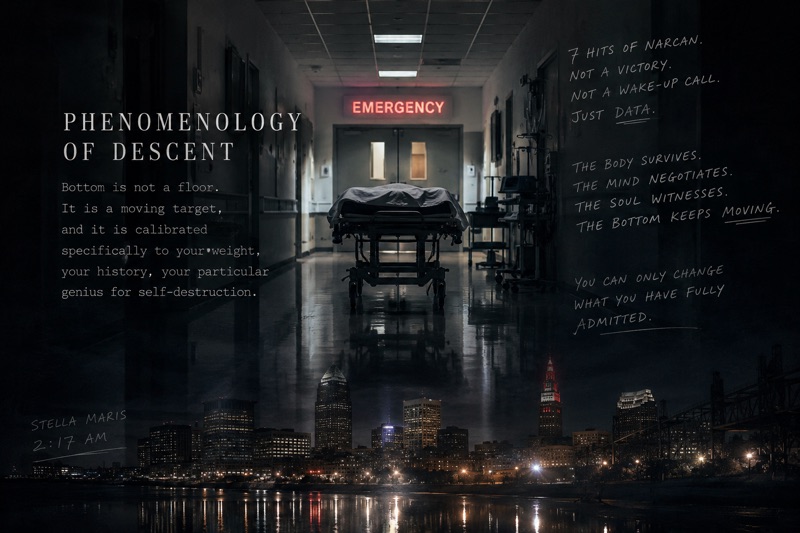
The truth is this: bottom is not a floor. It is a moving target, and it is calibrated specifically to your weight, your history, your particular genius for self-destruction. It sinks every time you reach for it, adjusting with the cruel intelligence of quicksand that has learned your patterns. You arrive thinking finally, this is as low as I can go, and the ground drops further, silent and unhurried, as if to say: not yet. Try again. The Lacanian Real doesn't announce itself — it simply swallows whatever symbolic scaffolding you mistook for solid ground.
You didn't understand any of that yet. What you understood was the next use, and the one after that, and the roulette-wheel logic of a body that had become a chamber you kept spinning. The clinical term is substance use disorder. The lived term is this: you had stopped asking whether you would survive and started asking, without quite admitting it, whether surviving was still the point.
The first major overdose carved itself into you like scripture.
You woke under fluorescent light. Not the warm, forgiving light of anything domestic or merciful — fluorescent light, which is a form of judgment, which is the light of institutions that process bodies, categorize them, decide what is salvageable and what is not. A hospital is a cathedral built on the premise that life is worth the intervention, and in that moment you were its reluctant communicant, flat on your back on a floor that had received you the way stone receives a fall: without apology, without softening.
A medic's chest was pressing against yours. Your ribs ached from compressions you had not requested and could not remember consenting to — someone else's hands performing the arithmetic of your continued existence, calculating on your behalf what you had stopped calculating for yourself. The body was contested territory. Your sternum bore the evidence of a negotiation conducted entirely without your conscious participation.
Your clothes were damp. Not with sweat. The distinction matters, and you know it immediately, the way the body knows its own shame before the mind has finished constructing its defenses: a pool of your own urine spreading beneath you, warm first, then cold, the temperature drop marking the precise boundary between the moment of crisis and the moment of aftermath. The source calls it an unholy baptism. That's accurate. Baptism is supposed to mark entry into a new life. What this marked was something more ambiguous — not entry, not exit, but suspension. You were still here. The question of whether that was mercy or punishment had not yet resolved itself.
Seven hits of Narcan, they told you later.
Seven.
The number has its own phenomenological weight. Seven is the threshold of a specific mathematics — the arithmetic of almost-dead, the calculation of how many times a body can be chemically dragged back from the edge before the edge wins. If you had needed an eighth, you would not be here. That sentence exists as both a medical fact and existential verdict. The staff delivered it as a warning. Your nervous system received it as a dare.
This is the rewiring that no one outside of it can fully map from the outside: addiction does not whisper, be careful. It does not respond to evidence the way a rational actor responds to evidence. It takes the number seven — seven rescues, seven doses, seven increments of borrowed time — and it performs a calculus that arrives at an answer no sober mind would endorse. It says: so there's a little room left. It says: let's see how close we can get this time. The Jungian shadow doesn't want to destroy you in any simple sense — it wants to test the absolute boundary, to find the terminal limit of what you can survive, because the part of you that has been in pain for a very long time has confused proximity to death with proof of existence.
You heard the number seven and felt something you would spend years learning to accurately name. It was not gratitude. It was not a relief. It was not the clarifying shame that is supposed to arrive at these moments in the narratives designed to reassure people that consequence and recognition move together in coherent sequence.
What you felt was closer to a competitive instinct gone catastrophically wrong. A dare accepted before it was fully extended. The echo of a consciousness that had been rewired so thoroughly that the near-extinction of the body registered as data about what was still possible rather than warning about what must stop.
The fluorescent light held you in its flat, merciless gaze. The floor was cold through your damp clothes. Your ribs ached with the pressure of hands that had refused to let the body complete its surrender. Somewhere in the institutional distance, the cathedral of emergency medicine continued its rituals — the clipboard, the intake form, the questions designed to assess orientation, the performance of a system that processes near-deaths with the procedural efficiency that is its own kind of grace.
You were alive. Technically. Chemically. By the arithmetic of seven interventions and the absence of an eighth.
And the bottom — the floor you thought you had finally located, the definitive threshold you believed you had hit — was already dropping beneath you again, silent and patient, waiting for the next time you would mistake its depth for ground.
═══
The speech itself was nothing new. You'd heard its architecture before — the same load-bearing beams, the same hairline cracks running through the plaster of their patience. You're wasting your life. You'll be out on your ass. I don't care if it's winter. The words arrived with the cadence of ritual, the kind of language families develop when they've run out of original grief and have to recycle what's left. You stood there and absorbed it the way a wall absorbs rain — not processing, not deflecting, simply taking it in until they were finished and the air in the room held that particular quality of exhausted aftermath, spent and slightly alkaline, like the smell after lightning.
Then you stepped outside.
Pepsi in hand. Smoke curling into whatever season the night was wearing. The back porch received you the way back porches do — without judgment, without expectation, with only the dumb patience of wood and screen and darkness. Their words still hung in the air around you, not yet dispersed, still audible at some frequency below speech. And then the chemistry that had taken up permanent residence in your nervous system did what chemistry does, and you nodded off.
Four hours. Maybe five. The arithmetic is imprecise because you weren't there for it. You were somewhere else entirely, or nowhere, which in certain philosophical traditions amounts to the same thing. The body stayed — slumped into itself on the porch, breathing in whatever shallow, compromised way it was managing — but you, the organizing consciousness that claims ownership of that body, had vacated. Time moved without you. The night deepened and then began its slow retreat toward morning, and none of it required your participation.
When something returned, it returned wrong.
The ringing came first. Not the delicate chime of a single bell but the full peal of something enormous and bronze, resonating inside your skull at a frequency that displaced thought, displaced breath, displaced everything except the fact of itself. Louder than cognition. Louder than fear. You staggered inside on legs that no longer seemed to belong to you, operating on the atavistic logic that horizontal was safer than vertical, that sleep could metabolize whatever this was, that the body knew how to handle its own emergencies.
But the body was in an emergency.
Every time you closed your eyes, your chest staged a small revolt. Your lungs — those loyal, uncomplaining organs that had processed ten thousand cigarettes and ten thousand nights of chemical insult without formal complaint — forgot the sequence. Forgot the rhythm. The breath came in shallow, came in wrong, came in intervals that widened like something being rationed. And the heart, that muscle which had been marking time through every catastrophe your nervous system had manufactured, began to lose count.
Fifty beats per minute. The number that would later be reported to you, reconstructed from monitors and nursing notes, the clinical record of your body's arithmetic. Then forty-one. The descent was not dramatic in the way descents are supposed to be — not a plunge, not a cinematic freefall, but something more methodical and therefore more terrifying. Twenty beats per minute. The heart became economical, shedding expenditures, operating on the reduced budget of a system shutting down its peripheral offices. Eight. Eight beats per minute, which is not a heart rate so much as a question, a body interrogating itself about whether continuation is worth the effort.
Somewhere in that calculus — somewhere in the fluorescent geometry of an emergency room you had no conscious memory of entering — voices reached across whatever distance had opened between you and the ordinary world. Stay with us, Matt. Stay with us. The nurses' plea, repeated, a kind of secular prayer directed at a body that was conducting its own referendum on existence. You heard it the way you hear sounds through water, attenuated and strange, arriving from a direction that didn't quite correspond to any compass point you knew.
Because here is what happened, and here is where language becomes inadequate and must be used anyway: you left.
Not metaphorically. Not in the soft, deflecting sense that people use when they mean dissociation, when they mean emotional withdrawal, when they mean the ordinary psychic retreat that consciousness performs under duress. Something that presented itself as you — some organizing awareness, some witness-function — separated from the body on the table and rose. Floated. The word sounds euphemistic but it is the most accurate available term for what you experienced, or what seemed to be experienced, and the distinction between those two formulations matters enormously and also, in the moment, not at all.
From wherever you were, you could see the ER staff working on something that was anatomically yours. The fluorescent lights performed their usual indifferent service, rendering everything clinical, draining color toward the blue end of the spectrum. There were hands, efficient and urgent, belonging to people who had committed their professional lives to the project of keeping bodies continuous with themselves. And there was your mother's face.
Her face.
Crumpled in the way that faces crumple when the grief exceeds the structural capacity of features to contain it — when the architecture of composure simply cannot bear the load any longer and everything folds inward toward some private epicenter of pain. You saw it. You saw her seeing what was being done to you, and you were above it, outside it, observing from a remove that felt, in its terrible way, like relief.
You did not want to come back.
That is the part that resists comfortable narration, the part that the redemption template cannot accommodate without distortion. It wasn't passive. It wasn't simply the absence of the will to return. There was something that functioned like preference, like inclination, in that floating place above the fluorescent lights and the urgent hands and your mother's demolished face. The body on the table was contested territory — claimed by the nurses, by the monitors, by your mother's love which is a force that operates outside the boundaries of any system that claims to measure force. And from wherever you had gone, the contest looked exhausting.
Something brought you back regardless. Or the body dragged you back, as bodies do, with their stupid insistent will toward continuation. The how of it remains beyond the reach of language, and you have decided to let it remain there rather than drape it in explanations that would only be decorative. You came back. The ceiling of wherever you'd been became the ceiling of the ER, which became the ceiling of your own skull, which became once again the only ceiling available to you.
You were still here. The math had not yet resolved against you. But you had seen, from the outside, what the equation looked like — the ER staff, the monitors, your mother's face folding into itself — and you had, in that floating place, registered something that felt nothing like gratitude.
═══
The ICU becomes your most reliable address. Not home—home implies return, implies something waiting for you, implies the geometry of belonging. This is a checkpoint. A station on a map you never consented to carry. You walk through the revolving door again and again, and each revolution costs something you cannot name on intake paperwork: a fraction of the person you were last Tuesday, a sliver of the capacity to believe this time will be different, some molecular percentage of the will that is supposed to distinguish human beings from their appetites.
You wake in the bed. You know two things with the clarity that only ICU fluorescence provides: you almost died. You will most likely use again. The arithmetic is that simple and that brutal, and no amount of clinical intervention changes the calculus.
The monitors are scripture. You learn to read them the way childhood taught you to read adult faces—for danger, for permission, for the gradient between worry and grief. Heart rate climbing then dipping. Oxygen saturation numbers ticking upward with agonizing patience. Blood pressure sliding sideways across the screen like a sentence losing its conviction. You watch these readings with the focus of a theologian parsing sacred text, because they are the only honest language available to you in this place. Everything else is softened—the nurses' voices clipped but careful, the attending physician's phrasing calibrated to the specific register of managed hope. The monitors do not manage. They simply report. They are the most honest witnesses you have ever had.
The fluorescent lights above your bed are another matter. They do not flicker here the way they do in the cheap rooms, the basement rooms, the rooms where the bulb considers giving up. ICU fluorescence is absolute. Totalizing. It flattens shadow, eliminates ambiguity, and refuses the mercy of darkness. The nurses move through it with a practiced efficiency that reads, in your compromised phenomenology, as something angelic—not divine and gentle, but divine and procedural, beings who practice resurrection the way other professionals practice law or accounting. They crack ribs when ribs need cracking. They push Narcan when the math requires Narcan. They perform the resurrection whether or not you asked for it, whether or not you wanted it, whether or not your first conscious emotion upon returning to your body was relief.
It was not a relief. Let that stand without decoration.
Then the withdrawal arrives, and the body becomes a contested territory that no treaty can hold. The tremors begin at the periphery—fingers, then hands, then the whole architecture of muscle and bone vibrating at a frequency that feels like the body broadcasting its own distress signal. Sweat arrives next, not the clean sweat of exertion but something older and more chemical, the body expelling the poison it simultaneously screams for. And the heart—the heart is the worst of it. Arrhythmic terror is the only accurate phrase: a pounding that loses its rhythm, skips its own beats, throws in extra ones without permission, a percussion section that has forgotten what song it was playing. You lie there tethered to the machines and you think, clinically, that this is how you die. Not from the drugs. From the absence of them.
You bargain with God in the same breath you curse Him. The two acts are not contradictory here; they are the same gesture. You make vows. You make them with the full sincerity available to a person whose sincerity has been systematically dismantled by years of renegotiation with their own conscience. The vows are real in the moment of their making. This is important to understand: you are not lying when you promise. You are simply operating on a timeline that does not survive contact with discharge paperwork. Those vows have expiration dates shorter than the IV drips keeping you alive, and everyone in that room—the nurses, the attending, your mother if she is there, the God you are simultaneously cursing and petitioning—understands this at a cellular level, even if no one says it in the language of plain speech.
You leave the ICU weaker in measurable ways. Muscle mass diminished. Blood chemistry is still recalibrating. Liver enzymes elevated in the specific pattern that tells a story without requiring your testimony. But the other thing—the hunger—that leaves stronger. This is the mechanism that no amount of fluorescent light or monitor scripture or arrhythmic terror manages to interrupt: addiction does not treat near-death as a warning. It treats near-death as data. Specifically, it treats near-death as evidence of proximity—of how close to the edge you can skate and still return, still walk out through the revolving door, still constitute, technically, a living person.
Each overdose you survived did not warn you off the ledge. It recalibrated where the ledge was. It whispered—and addiction always whispers, never shouts, because shouting would break the spell—it whispered: see, you came back. See how close we can get. The ICU became proof of invincibility even as your body kept submitting counter-evidence. The body was losing the argument. The addiction kept changing the terms of debate.
And yet. Even in those rooms, in that absolute fluorescent judgment, in the tremors and the sweat and the arrhythmic proof that your body was running out of patience with your decisions—even there, something persisted that was not the addiction. Something small and stubborn and not yet fully extinguished. Not hope, exactly. Not the word people use in treatment facilities and twelve-step rooms, the word that sounds too clean for where you are. Something more like the last ember in a structure that has otherwise fully burned. Not hope. Persistence. The distinction matters.
You wanted out. You wanted something on the other side of this. You just had not yet found the mechanism. You were still doing the math—the arithmetic of almost-dead—and the equation kept returning the same answer: not yet. Not this time. The door revolves again. You walk back through it.
═══
Here is the thing about the bottom that nobody warns you about: it keeps moving.
Not because the universe is careless with its coordinates. Because the target is intelligent. Quicksand programmed with cruel precision, calibrated specifically to your weight, your patterns, your particular velocity of self-destruction. Every time you arrive with the relief of finality—this is it, this is the floor, this is as low as the architecture of a life allows—it drops again. Adjusts. Waits for you with something that feels almost like patience, almost like cruelty, almost like knowledge of how you are built and exactly how much further you can fall before the structure gives.
You kept doing the arithmetic. Seven hits of Narcan. Then the back porch. Then the next time, and the one after that, each occasion its own separate roulette spin, the chamber clicking through positions you stopped counting because counting required a belief in futures you no longer possessed. The math kept not adding up to death, which you eventually stopped experiencing as luck and started experiencing as something else. Something without a clean name. Disappointment lives in that neighborhood. So does rage. So does the terrible, unanswerable question of why the body keeps insisting on its own continuation when the mind has filed for separation.
This is where the contradiction lives, and it is not a small one. You resented the rescue. You genuinely, bone-deep resented the medics with their compressions and their Narcan, resented the fluorescent corridors and the intake forms and the faces performing concern at you. Resented the machinery of salvation for its presumption. And simultaneously—beneath the resentment, below the calcified layer of contempt—you were terrified it wouldn't come. That the next spin would be the one where no one found you in time. That the dare would finally be called.
You cannot hold both of those feelings without fracturing, so you didn't. You dissociated from the contradiction the way you dissociated from everything that threatened the fiction of control. You performed gratitude in hospital beds and meant none of it. You performed contempt for the whole apparatus of intervention and meant all of it. Neither performance was the truth. The truth was the thing underneath both, the thing you couldn't yet look at directly: you were not sure you deserved to be rescued, and you were not sure you wanted to find out.
Lacan called it the encounter with the Real—that traumatic kernel which resists all symbolization, all the clean narrative frameworks the ego constructs to make existence legible. The Imaginary self, the one you preferred, the slot receiver, the golden boy, the one with the laugh that reset rooms: gone. The Symbolic self, the one recognized and interpolated by others, by institutions, by the machinery of social meaning: collapsed. What remained when both fell away was not nothing. It was worse than nothing. It was the unmediated thing you had been running from since Willow Avenue taught you that ground could vanish, that love was negotiable, that home was just a word people used because silence terrified them.
Bottom is not the external consequences, though those were real enough—the ribs aching from compressions you didn't ask for, the clothes damp with shame, the pool of your own urine spreading beneath you in a baptism no one would choose. Those are symptoms. Coordinates. Evidence, not verdict.
The verdict comes from the one witness you cannot evict.
You looked at yourself. Not in the bathroom mirror you'd learned to navigate by peripheral avoidance, but in the unguarded moments—the dead phone screen, the bus window, the store glass catching you sideways when your defenses were occupied elsewhere. And the man looking back was not a stranger exactly, which was the part that broke something. A stranger would have been easier. This was recognizably you, recognizably the person who had once held something real in his hands, and the distance between who that person had been and what was standing in front of the reflection was not tragedy in the cinematic sense. It was arithmetic. Accumulated subtraction. Years of trading the irreplaceable for the temporary, clarity for silence, the future for another hour of not feeling what was waiting to be felt.
And here is the cruelest mechanism in the whole apparatus: you can only arrive at that recognition by staying with it. By not looking away. By holding your own gaze in the cheap light of whatever room the descent has deposited you in, and not reaching for the exit, and not constructing the next rationalization, and not performing the emotions that the situation seems to require.
No music rises. No one witnesses the moment. The people who might have cared have already been driven away by the geometry of your addiction, their departures each rationalized into irrelevance until the room is empty and the only person left to hold the verdict is you.
This is not a floor. A floor implies something solid enough to stand on, something that supports weight and allows for the construction of whatever comes next. The bottom is not that. The bottom is a mirror. It shows you only what you have been. It offers no instructions. It does not tell you whether the thing reflected back is salvageable. It does not perform hope.
What it performs is truth. Stripped of the Imaginary self you preferred. Stripped of the Symbolic self others recognized. Just the Real, which is to say just you, just the actual unremediated fact of what the choices accumulated into, the thing that was always there beneath the layered performances of functionality.
And here, at the precise location where this should feel like an ending, is where the logic flips.
You can only change what you have fully admitted. You can only rebuild what you have stopped pretending isn't rubble. You can only walk out of the descent once you have stopped calling it something else, once you have surrendered the last fiction about the fire being warmth.
The recognition is not recovery. It is not a victory. It is not the beginning of a clean arc toward redemption. It is simply the first moment in which change becomes structurally possible—not guaranteed, not even likely, just possible, the way a door is possible when you are finally willing to acknowledge you have been standing in front of it.
Bottom is the invitation..
Comments
Post a Comment